


Description
D-Link DGS-1210-28 — 28-Port Gigabit Smart Managed Switch
The D-Link DGS-1210-28 is a 28-port Layer 2 Smart Managed Switch built for networks that need more control than an unmanaged switch can offer, without the cost or complexity of a fully-managed enterprise switch. It sits in that practical middle ground — VLANs, QoS, link aggregation, and security features that growing networks actually need, wrapped in a simple, fanless desktop or rack-mount unit.
For buyers in Pakistan setting up office networks, campus deployments, retail environments, or ISP edge infrastructure, the D-Link DGS-1210-28 is one of the most widely deployed smart switches in its class, offering enterprise-style features at a price point that fits small and mid-sized budgets.
D-Link DGS-1210-28 Port Layout: 24 Gigabit Ports Plus 4 Combo Ports
At its core, the D-Link DGS-1210-28 provides 24 × 10/100/1000BASE-T RJ45 Gigabit ports, giving you plenty of room to connect workstations, access points, IP cameras, and servers directly without needing a second switch in most small-to-mid office setups.
Alongside these, the D-Link DGS-1210-28 includes 4 × 100/1000 Mbps Gigabit RJ45/SFP combo ports. These combo ports can be used as standard copper Gigabit ports or populated with SFP transceivers for fiber uplinks — a flexible design that lets the same switch handle both a fully copper network and one that needs a fiber connection back to a core switch, router, or ISP handoff point.
This mix of 24 dedicated copper ports and 4 flexible combo ports is a large part of why the D-Link DGS-1210-28 works equally well as an access-layer switch in an office and as a distribution switch tying together multiple smaller switches on a campus network.
Switching Performance: Built for Real Traffic Loads
The D-Link DGS-1210-28 offers a switching capacity of 56 Gbps and a packet forwarding rate of 41.7 Mpps, which is enough headroom for full wire-speed switching across all 28 ports simultaneously under typical office or campus traffic patterns.
Behind this, the switch carries an 8K-entry MAC address table with support for 256 static MAC addresses, along with 4.1 Mbits of packet buffer memory to smooth out bursts of traffic without dropping packets. The D-Link DGS-1210-28 is powered by a DDR3 128MB CPU memory and 32MB of flash storage, which is enough to run its full feature set — VLANs, ACLs, QoS queues, and management services — without slowing down under normal administrative load.
Jumbo frame support up to 10,000 bytes is also included, which matters for networks handling storage traffic, backups, or large file transfers where oversized frames reduce CPU overhead compared to standard-sized packets.
VLAN and Network Segmentation on the DGS-1210-28
Network segmentation is one of the biggest reasons buyers choose a smart managed switch over an unmanaged one, and the D-Link DGS-1210-28 covers this well. It supports 802.1Q VLAN tagging with up to 256 static VLANs, giving administrators the ability to separate traffic for different departments, guest networks, or security zones on the same physical switch.
Beyond basic VLANs, the D-Link DGS-1210-28 includes Auto Voice VLAN and Auto Surveillance VLAN features, which automatically detect and prioritize VoIP phones and IP cameras on the network — a genuinely useful feature for offices deploying VoIP handsets or CCTV systems without wanting to manually configure a VLAN for every new device. Asymmetric VLAN support rounds this out, allowing more flexible sharing of common resources like a printer or internet gateway across multiple VLANs where needed.
Link Aggregation and Spanning Tree for Reliable Uplinks
For networks that need more bandwidth or redundancy between switches, the D-Link DGS-1210-28 supports IEEE 802.3ad LACP link aggregation with up to 8 groups, allowing multiple physical ports to be bonded into a single logical link for higher throughput and failover between switches, servers, or a firewall.
To prevent loops in networks with redundant links, the D-Link DGS-1210-28 also supports the full range of spanning tree protocols — STP (802.1D), RSTP (802.1w), and MSTP (802.1s) — so administrators can build resilient topologies with backup paths that automatically activate if a primary link fails, without worrying about broadcast storms.
Quality of Service for Voice, Video, and Priority Traffic
Traffic prioritization is handled through 8 queues per port on the D-Link DGS-1210-28, with support for WRR (Weighted Round Robin) scheduling, 802.1p class-of-service tagging, and DSCP-based classification. This lets administrators make sure that latency-sensitive traffic — VoIP calls, video conferencing, or surveillance feeds — gets priority over less time-sensitive traffic like file downloads or backups, which is particularly useful in offices running voice and video services over the same network as everyday data traffic.
Static Routing Capabilities
While it’s primarily a Layer 2 switch, the D-Link DGS-1210-28 also includes limited Layer 3 functionality, supporting 124 IPv4 static routes and 50 IPv6 static routes. This allows the switch to route traffic between a small number of VLANs or subnets directly, without necessarily needing a separate router for simple inter-VLAN routing scenarios — useful for smaller networks that want basic routing without the cost of a dedicated Layer 3 device.
Security Features Built Into the DGS-1210-28
Security is one of the stronger points of the D-Link DGS-1210-28 for a switch in its price class. It includes ACL (Access Control List) support for filtering traffic based on defined rules, 802.1X port-based authentication for controlling which devices can join the network, and SSH v2 along with TLS 1.3 for encrypted remote management sessions.
On top of that, the D-Link DGS-1210-28 includes ARP spoofing prevention, DHCP snooping, IP-MAC-Port binding, and DoS protection — a combination of features that helps guard against common LAN-based attacks like rogue DHCP servers, ARP poisoning, and IP spoofing. For offices or campus networks handling sensitive data, or where compliance requirements call for documented network access controls, these built-in protections are a meaningful upgrade over what an unmanaged switch can offer.
Management Options for the DGS-1210-28
The D-Link DGS-1210-28 can be managed through a Web GUI for straightforward day-to-day configuration, a CLI over Telnet for administrators who prefer command-line control, and SNMP v1/v2c/v3 for integration with existing network monitoring systems. D-Link Network Assistant software is also supported, which is useful for discovering and configuring multiple D-Link switches across a network from a single tool.
For reliability during firmware updates or configuration changes, the D-Link DGS-1210-28 supports Dual Image and Dual Configuration, meaning administrators can keep a backup firmware image and a backup configuration on hand, reducing the risk of a failed update leaving the switch inaccessible.
Green Ethernet and Power Efficiency
The D-Link DGS-1210-28 supports IEEE 802.3az Energy Efficient Ethernet, which reduces power draw on ports connected to idle or lower-speed devices. Actual power consumption is rated at a maximum of 17.32W at 100V (16.94W at 240V), dropping to just 6.49W (100V) / 6.55W (240V) in standby — a low draw that keeps running costs down for a switch handling 28 ports of traffic around the clock.
This efficiency also keeps heat output low, with the D-Link DGS-1210-28 rated at 59.09 BTU/hr (100V) or 57.79 BTU/hr (240V) — modest enough that the switch doesn’t need active cooling at all.
Fanless, Silent Operation
Cooling on the D-Link DGS-1210-28 is entirely passive — there’s no fan and no moving parts, resulting in 0 dB acoustic operation. This matters for offices, classrooms, retail counters, or any space where switch noise would otherwise be a distraction, and it also removes a common point of mechanical failure found in fan-cooled switches.
Build Quality and Environmental Rating
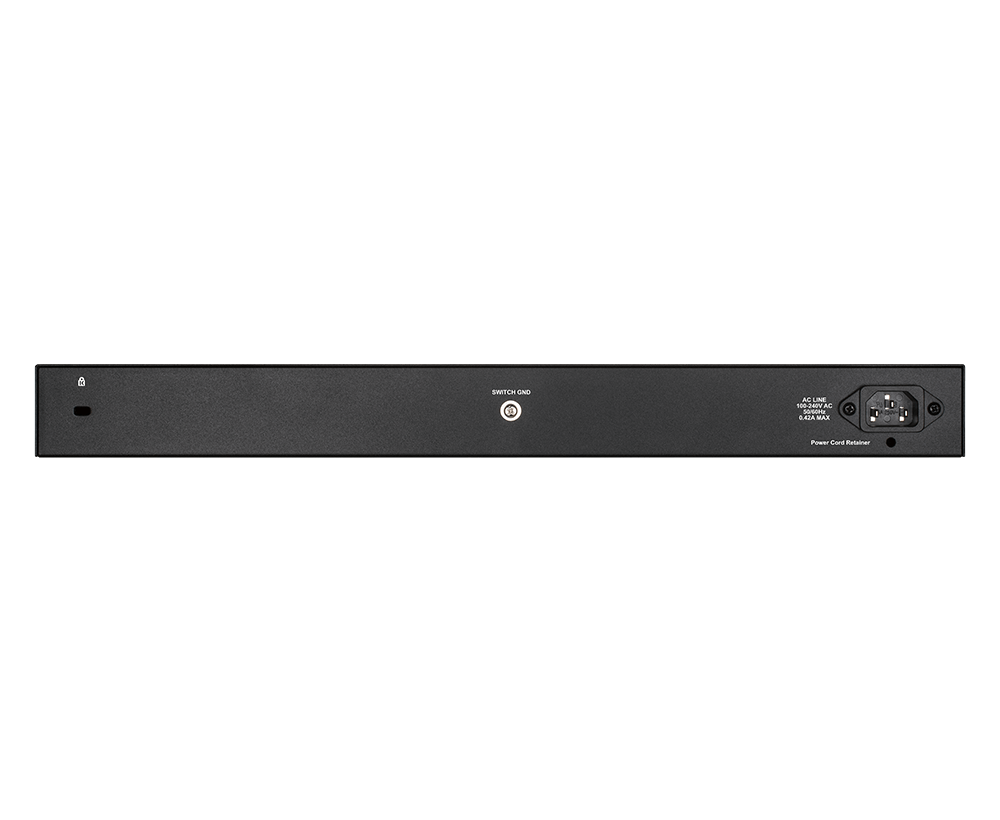
The D-Link DGS-1210-28 measures 440 × 140 × 44mm and weighs 2.15 kg, with a design that supports both desktop placement and 19″ rack mounting — rack brackets are included in the box, so no separate purchase is needed either way.
It’s rated to operate across a temperature range of -5°C to 50°C, with a wider storage temperature range of -20°C to 70°C, and tolerates 0–95% relative humidity (non-condensing). This makes the D-Link DGS-1210-28 suitable for a range of environments across Pakistan, from air-conditioned server rooms to less climate-controlled office or retail spaces, though it’s still an indoor-rated device rather than one built for direct outdoor exposure.
MikroTik-style reliability figures apply here too — the D-Link DGS-1210-28 carries an MTBF (Mean Time Between Failures) rating of 992,594 hours, a strong figure that reflects confidence in long-term, always-on operation in office and campus environments.
Compliance and Certifications
The D-Link DGS-1210-28 carries CE, FCC, VCCI, BSMI, CB, UL, and LVD certifications, along with CQC compliance — a broad set of international certifications that cover safety and electromagnetic compatibility standards across multiple regions. This is particularly relevant for businesses, educational institutions, or government deployments in Pakistan where compliance documentation may be required for procurement.
Common Use Cases for the DGS-1210-28
Given its port density, VLAN and QoS capabilities, and built-in security features, the D-Link DGS-1210-28 fits a wide range of deployment scenarios. Small and mid-sized offices use it as a core access switch, connecting workstations, printers, and Wi-Fi access points while keeping departmental traffic segmented through VLANs.
Retail and hospitality environments benefit from the Auto Surveillance VLAN and Auto Voice VLAN features, which simplify deploying IP cameras and VoIP phones without extensive manual configuration. Educational institutions and campuses often rely on the D-Link DGS-1210-28’s 802.1X authentication and ACL support to control device access across shared network infrastructure, while its link aggregation and spanning tree support make it a solid choice for tying together multiple switches in a larger building or multi-floor deployment.
ISPs and WISPs also use switches like the D-Link DGS-1210-28 at aggregation points, taking advantage of the SFP combo ports for fiber uplinks back to core infrastructure while serving copper-connected customer equipment locally.
How the DGS-1210-28 Compares to Unmanaged Switches
The core advantage of the D-Link DGS-1210-28 over a basic unmanaged Gigabit switch comes down to control and visibility. An unmanaged switch simply forwards traffic with no way to segment networks, prioritize voice or video traffic, or lock down which devices can connect. The D-Link DGS-1210-28, by contrast, gives administrators VLANs, QoS, ACLs, and authentication — all through a smart-managed interface that’s considerably simpler to learn than a full enterprise-grade managed switch, while still covering the features most small and mid-sized networks actually need day to day.
Why Choose the D-Link DGS-1210-28
The D-Link DGS-1210-28 combines a generous 28-port Gigabit layout with real VLAN, QoS, and security features, silent fanless operation, and flexible desktop or rackmount installation. For buyers in Pakistan looking to move beyond unmanaged switching without taking on the cost and complexity of a full enterprise switch, the D-Link DGS-1210-28 offers a practical, well-rounded option that’s equally at home in an office, a campus wiring closet, or as part of a larger ISP network build-out.

Reviews
There are no reviews yet.