


Description
MikroTik RBD52G-5HacD2HnD-TC hAP ac² — Dual-Concurrent Gigabit Access Point in a Universal Tower Case
The MikroTik RBD52G-5HacD2HnD-TC hAP ac² is a dual-concurrent wireless access point designed for homes, small offices, and SOHO environments that need strong dual-band WiFi paired with full Gigabit wired connectivity.
It combines simultaneous 2.4GHz and 5GHz wireless, five Gigabit Ethernet ports, USB expandability, and IPsec hardware acceleration into a single compact unit with a flexible universal case design — making the MikroTik RBD52G-5HacD2HnD-TC hAP ac² a practical choice for buyers in Pakistan who want more performance and configuration depth than a typical ISP-supplied router offers, without stepping into enterprise-grade pricing.
Whether you’re setting up WiFi for a home, replacing an aging router in a small office, or want a compact access point that can also serve as a full RouterOS-based router, the hAP ac² is designed to be simple to deploy while giving access to the full depth of MikroTik’s RouterOS platform.
MikroTik RBD52G-5HacD2HnD-TC Performance: Quad-Core Power in a Compact Package
At the core of the MikroTik RBD52G-5HacD2HnD-TC hAP ac² is a quad-core IPQ-4018 CPU running at a nominal 716 MHz (with an auto-scaling range of roughly 488–896 MHz depending on load), paired with 128MB of RAM.
This quad-core design gives the hAP ac² noticeably more processing headroom than many single-core or dual-core routers in its price class, which matters when the device is simultaneously handling dual-band wireless, routing, firewall rules, and any VPN tunnels running in the background. In practice, this means the MikroTik RBD52G-5HacD2HnD-TC hAP ac² stays responsive under multitasking network loads rather than bogging down as more devices connect and more traffic passes through it.
The router runs RouterOS with a Level 4 license already included, meaning no separate software purchase is required — the MikroTik RBD52G-5HacD2HnD-TC hAP ac² is ready to configure and deploy straight out of the box, and comes preconfigured so that in many cases all that’s needed is plugging in the internet cable and power, then connecting to the MikroTik wireless network to get started.
A particularly useful feature built into the MikroTik RBD52G-5HacD2HnD-TC hAP ac² is IPsec hardware acceleration, which offloads the heavy computational work of encrypting and decrypting VPN traffic to dedicated hardware rather than relying purely on the CPU. This means that even with its modest CPU clock speed, the hAP ac² can maintain solid throughput on encrypted site-to-site VPN connections or secure remote access tunnels — a feature not always found on access points at this price point, and one that makes the hAP ac² noticeably more capable for small business use cases where secure connectivity to a head office or cloud service matters.
MikroTik RBD52G-5HacD2HnD-TC Wireless: True Dual-Concurrent 2.4GHz and 5GHz Coverage
The defining feature of the MikroTik RBD52G-5HacD2HnD-TC hAP ac² is its dual-concurrent wireless design, which provides WiFi coverage for 2.4GHz and 5GHz frequencies at the same time rather than forcing a choice between the two.
On the 2.4GHz band, the hAP ac² uses built-in dual-chain 802.11b/g/n wireless with an integrated antenna, offering broad compatibility with older client devices, IoT gadgets, and anything that doesn’t support 5GHz. On the 5GHz band, it uses dual-chain 802.11a/n/ac wireless, also with an integrated antenna, delivering the faster throughput and reduced interference typically associated with the 5GHz spectrum and the 802.11ac standard.
Running both bands simultaneously means that a household or small office using the MikroTik RBD52G-5HacD2HnD-TC hAP ac² doesn’t have to compromise: older 2.4GHz-only devices like some smart home gadgets or older laptops can connect on that band, while newer phones, laptops, and streaming devices can take advantage of the faster, less congested 5GHz band — all from a single access point.
MikroTik RBD52G-5HacD2HnD-TC Connectivity: Five Gigabit Ports and USB Expansion
Connectivity is another area where the MikroTik RBD52G-5HacD2HnD-TC hAP ac² stands out from many entry-level access points. It includes 5 x 10/100/1000 Gigabit Ethernet ports, giving every wired device connected to it full Gigabit speeds rather than the 100Mbps ports found on some of MikroTik’s older or more budget-oriented models.
This matters in practice for anyone running NAS devices, gaming consoles, desktop workstations, or a wired backhaul to another access point or switch — all of these benefit from full Gigabit throughput rather than being bottlenecked by a slower Fast Ethernet port. With five ports available, the MikroTik RBD52G-5HacD2HnD-TC hAP ac² can comfortably serve as the central hub for a small office’s or home’s wired network, alongside its wireless duties.
Beyond Ethernet, the hAP ac² includes a USB port that can be used in one of two ways: connecting external storage for simple file sharing or backups, or connecting a 4G/LTE USB modem to provide a mobile broadband connection — either as a primary internet source in an area without reliable fixed-line broadband, or as a failover connection if the main internet line goes down. This flexibility is a meaningful advantage for small businesses in Pakistan operating in areas where internet reliability can vary, since the MikroTik RBD52G-5HacD2HnD-TC hAP ac² can be configured to automatically switch to a cellular backup connection during an outage.
Flexible Powering with PoE Support
The MikroTik RBD52G-5HacD2HnD-TC hAP ac² can be powered from its DC power jack using the included 24V 0.8A power adapter, or through Passive PoE, with Port 1 supporting Passive PoE In. This gives installers flexibility in how they run power to the device, particularly useful in ceiling-mounted or wall-mounted installations where running a dedicated power outlet to the access point’s location isn’t convenient, but a PoE-capable switch or injector is available elsewhere on the network.
Universal Case Design: Desktop or Tower, Your Choice
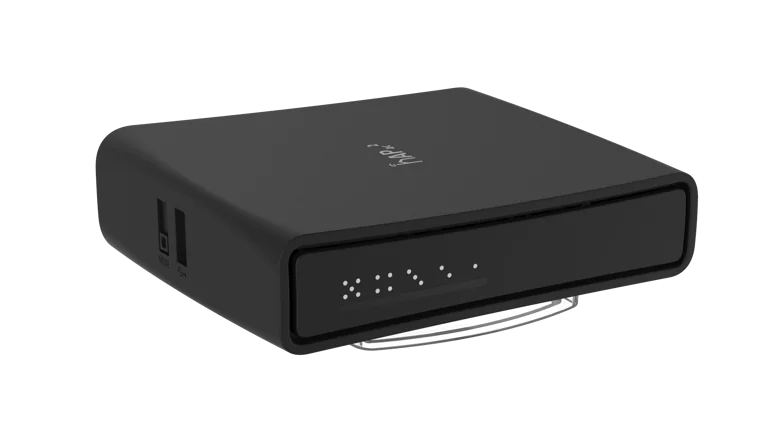
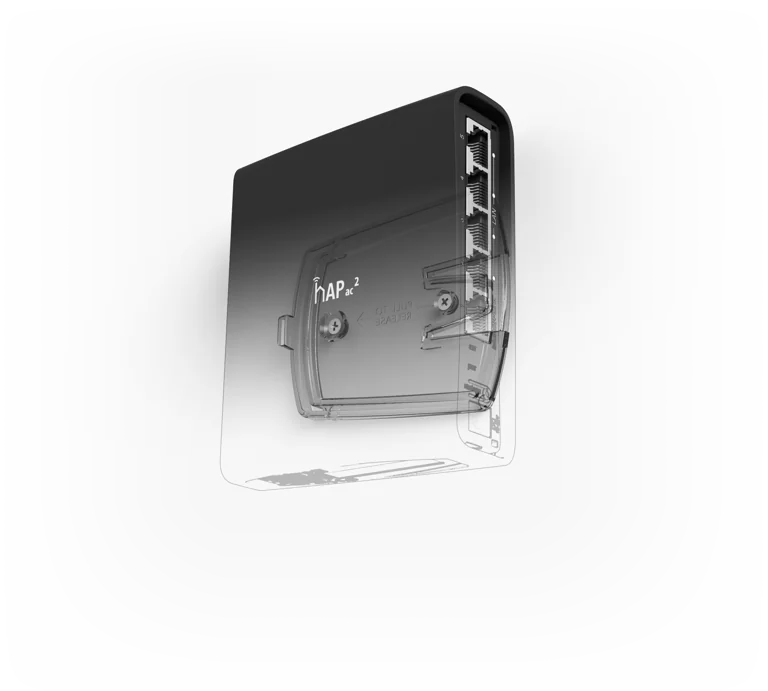
One of the more distinctive design elements of the MikroTik RBD52G-5HacD2HnD-TC hAP ac² is its universal case, which allows the unit to be positioned either horizontally as a traditional desktop device or vertically as a tower case. This flexibility means the hAP ac² can adapt to whatever space is available — laid flat on a shelf or media console, or stood upright to take up less desk or counter space in tighter environments.
A wall-anchored mounting kit is also included in the box, giving buyers the option to mount the MikroTik RBD52G-5HacD2HnD-TC hAP ac² on a wall entirely, which can help with both signal coverage and keeping the unit out of the way in busy home or office environments.
The compact dimensions of 34 x 119 x 98mm and light weight of roughly 0.4 kg make the hAP ac² easy to place discreetly regardless of which orientation is chosen, without the bulk of larger rackmount or tower-style networking equipment.
Included Software License and Updates
RouterOS comes preinstalled and fully licensed (Level 4) on the MikroTik RBD52G-5HacD2HnD-TC hAP ac² — there’s no separate software purchase needed to start using it. This Level 4 license unlocks the full range of RouterOS features relevant to a device in this class, including advanced firewall rules, bandwidth shaping and QoS, VLAN support, multiple VPN protocols, and centralized management options for those overseeing more than one MikroTik device.
MikroTik continues to release regular RouterOS updates for the platform, meaning buyers of the MikroTik RBD52G-5HacD2HnD-TC hAP ac² benefit from ongoing bug fixes, security patches, and new features well beyond the initial purchase date, without needing to buy new hardware to stay current.
Who Should Consider the MikroTik RBD52G-5HacD2HnD-TC hAP ac²
This access point is best suited for buyers who want strong dual-band WiFi, full Gigabit wired ports, and genuine RouterOS configuration depth, all in a flexible, compact form factor. Common use cases for the MikroTik RBD52G-5HacD2HnD-TC hAP ac² include:
Home Networks Wanting Better Coverage and Control — Households outgrowing their ISP-supplied router often turn to the hAP ac² for its simultaneous dual-band WiFi, Gigabit wired ports, and the ability to fine-tune firewall rules, guest networks, and parental controls through RouterOS.
Small Office and SOHO Deployments — With five Gigabit ports, dual-band wireless, and IPsec hardware acceleration for secure VPN connections, the MikroTik RBD52G-5HacD2HnD-TC hAP ac² is well equipped to serve as the primary router and access point for a small office, particularly one that needs to connect securely back to a head office or cloud resource.
Mobile Broadband Backup Setups — Because of its USB port supporting 4G/LTE modems, the hAP ac² is a strong choice for businesses in areas where internet reliability isn’t guaranteed, letting them configure automatic failover to a cellular connection during outages.
Flexible Installation Environments — The universal desktop/tower case design and wall-mounting option make the MikroTik RBD52G-5HacD2HnD-TC hAP ac² adaptable to a wide range of physical spaces, from a media shelf to a wall-mounted position in a hallway or office.
RouterOS Enthusiasts and Home Lab Builders — For anyone wanting to explore MikroTik’s RouterOS ecosystem with a device that includes real wireless capability alongside full routing features, the hAP ac² offers a well-rounded entry point without a steep price jump.
How the hAP ac² Compares to MikroTik’s Other Home Access Points
Compared to the more budget-oriented hAP ac lite, the MikroTik RBD52G-5HacD2HnD-TC hAP ac² offers a meaningful step up: Gigabit Ethernet ports instead of Fast Ethernet, a quad-core CPU instead of a single core, more RAM, and IPsec hardware acceleration for faster encrypted VPN throughput. For buyers deciding between the two, the hAP ac² is generally the better choice for anyone planning to use wired Gigabit devices, run VPN connections regularly, or expects to place more demand on the router’s processing capability over time.
Why Choose the MikroTik RBD52G-5HacD2HnD-TC hAP ac²
The MikroTik RBD52G-5HacD2HnD-TC hAP ac² brings together dual-concurrent 2.4/5GHz wireless, five Gigabit Ethernet ports, USB expansion for storage or mobile broadband, IPsec hardware acceleration, and a flexible universal case design — all backed by a fully licensed RouterOS installation.
For buyers in Pakistan looking for a MikroTik RBD52G-5HacD2HnD-TC hAP ac² that delivers genuine Gigabit performance, dependable dual-band wireless coverage, and the configuration depth of RouterOS in a compact, adaptable package, this model remains one of MikroTik’s most well-rounded and popular access points for home and small office networking.





Reviews
There are no reviews yet.